Why is a gap not a zero?
A planned hour without a report, open gaps with their deadline, late reports, closing and addendum.
5 minute readAnalyticsUpdated: 10/25/2026
On this page
Before you start
- For
- Everyone who passes on numbers and has to stand behind where they come from.
- Prerequisite
- The permission Run ad hoc queries, held by Owner and Manager by default.
- Where in the portal
- Analytics › Overview and Displays tabs
A planned hour without a report appears in analytics as a gap, not as a zero. The difference decides whether a proof is a measurement or a claim. That includes what happens to reports that arrive later, even after a month has been closed.
A zero would be a claim
A zero would mean: The display was running and showed nothing. A gap means: We do not know. The device was offline, switched off, or not yet in operation. Folding both into one number would be a statement about something nobody measured. That is why analytics never estimates.
Gaps exist only within the planned time, that is, in the hours in which a display should show content according to opening hours and program. A shop whose displays are off at night has no planned time at night and therefore no gap. Conversely, a display that is silent during planned time is the biggest gap and does not disappear from the calculation: Every display counts, even one that has never reported.
A planned hour has three states. Only the third is a gap, and it is never estimated.
What a gap looks like
Color is never the only carrier of meaning. A gap is hatched in amber, a panel on standby is slate-colored, and every cell carries its plain text for the keyboard and for a screen reader. The grid Every planned hour of the week in the Overview tab shows one cell per display and hour, and half cells are half opening hours. The legend below it names visible, reported late, panel off, not in the foreground, not reported, 3 or more playback errors, and no planned time.
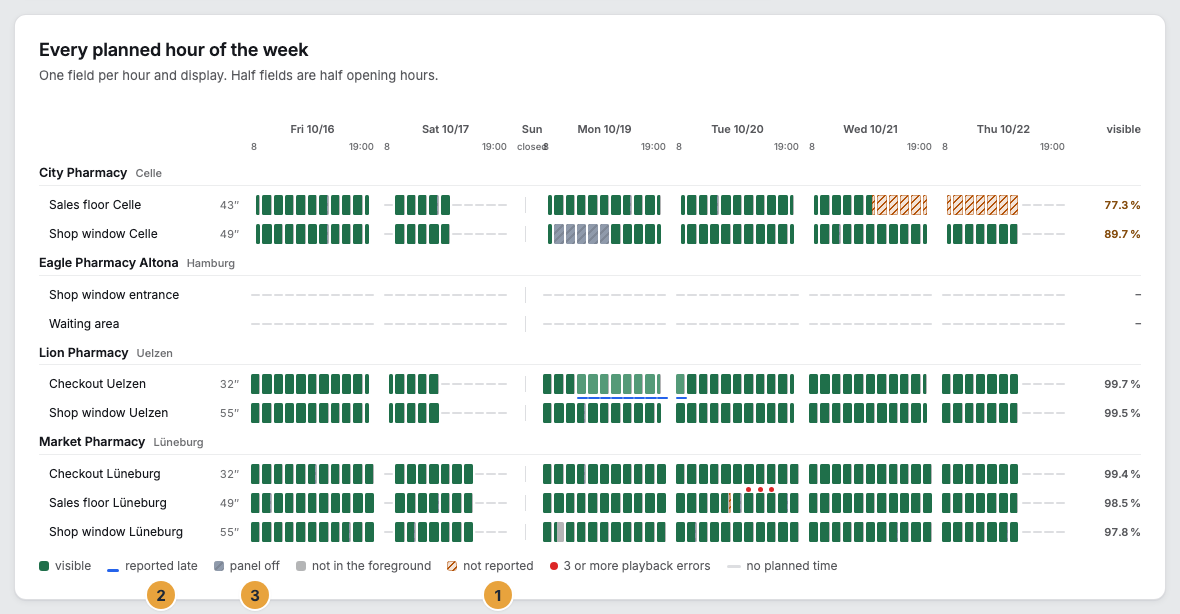
1 not reported · 2 reported late · 3 panel off
Late reports and open gaps
A device without a network keeps measuring. Its reports stay on the device for up to seven days and go out as soon as it is reachable again. Whatever arrives more than 15 minutes after the end of an hour is reported late: measured on the device exactly like everything else, only arrived later. The card Completeness of measurement counts the planned hours as on time, reported late, and not reported.
As long as a device can still report late, its gap is open: for seven days after the affected hour. During this time, analytics says what may still arrive instead of stating a final number:
| Where | What it says |
|---|---|
| Availability in the Overview | “Up to … once the open gap of … is reported. A gap never counts as zero.” Availability is then a range between what is on file and what it would be if everything arrives. |
| Not reported in the card Where the planned time went | “… since … Can still arrive.” with the addition open. The card names the open gap with the greatest impact, not the one whose window ends first. It does not name stretches of up to ten minutes. |
| Anomalies | “… has not reported since …” with the addition open. |
| Day of a display | “… planned hours of this day have not been reported yet and may arrive until …. The figures may still rise.” |
When the window has passed, the gap becomes final: “… did not report …. The window for late reports has passed. This time stays a gap.”
Closing and addendum
Ad campaigns need a state that still holds tomorrow. That is why every month of a booking is closed: 72 hours of late reporting window after its last day and another 24 hours of safety margin, in the night that follows. The closing cannot be changed, and the signed proof refers to it.
If a report for this month still arrives after that, it does not change the closing. It appears in an addendum with a number of its own, which contains only the plays delivered afterward. Closing and addendum refer to each other, and together they make up the whole delivery of the month. That way every number stays verifiable, even if a device reports late after a long weekend without a network.
What follows
- A proof does not hide gaps, it reports them: Coverage of the planned time and the unreported and late-reported hours appear in the Quality section.
- Use the figures of a running month only with reservations. What happened yesterday can still grow.
- A gap is a reason to look at the display, not a number to calculate away: Check a display’s day.
- Enter opening hours, or the planned time counts every program hour and reports gaps where nobody is looking: Create locations and assign displays to them.
- More on closing, addendum, and verification: Proofs and links for advertisers.
Found what you needed? Then carry on in the portal — or set up an organization first.
Go to the portalTry it free